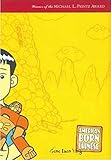
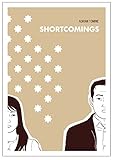
My latest graphic novel was Jimmy Corrigan, or, The Smartest Boy on Earth, by Chris Ware. Initially I wasn't sure if I was going to like this book, because the illustrations are quite busy, the writing tiny and sometimes hard to read, and it looked like it might be more kid oriented than the other books I had read thus far. Boy, was I wrong. I mean, the pages ARE quite busy (see above), and the writing was sometimes difficult to read (especially when italicized), but the story itself was sad and amazing. Jimmy Corrigan is approaching middle age, and has never met his father. His life is dominated by his mother, and he both needs her and wishes she would leave him the hell alone. And the rest of the time, he is alone. He lusts in a schoolboy way over a waitress in a local coffee shop, but is too shy to talk to her. He doesn't even notice the woman who worked on the other side of his cubicle wall for 6 months. He is the epitome of emotional isolation.
The book tells the story of his meeting with his father, which is mostly a dud. His dad is a bombastic blow hard, who tells inappropriate stories and gets excessively angry with a waitress who messes up his order...and Jimmy is passive enough to go fix the order with the waitress, but then ends up paying for the fixed burger, when it was the waitresses fault to begin with. The story weaves between the past, the distant past (the tragic story of Jimmy's grandfather's youth with an abusive father), and fantasies of being a superhero, a robot, anything.
Jimmy's coping mechanisms are heart-breaking, but his grandpa's story was the one that made me cringe inside. There's a scene where he goes to an immigrant friend's house with a group of kids, to make figurines out of clay or something, and the grandpa (also named Jimmy) waits and waits for the friend's father to irrationally lose his temper, to curse and yell and explode in his anger. When that doesn't happen, when the man shows actual warmth toward the kids, and praises Jimmy's horse figurine, Jimmy attaches himself to the man, and starts to fantasize about staying there forever. Of course, his father comes and drags him home, with him crying the whole time. Ugh.
Not an easy read on the eyes or the heart, but a touching and brilliant peek into the inner workings of an emotionally stunted character. Highly recommended, again. I might have to give a few more graphic novels a shot, I'm thinking.


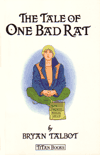
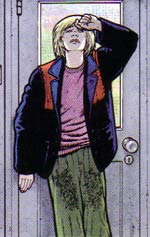 From that beginning, he took the image of a young homeless girl being harassed by a bearded 'Jesus Freak', (his words) in the Tube, and constructed a tale around her. For the girl to be homeless, Mr. Talbot decides that she needs a reason to have left home. So his character is the victim of sexual abuse by her father, and neglect and uncaring by her mother. Left to many authors, this story might have been heavy handed, but Mr. Talbot clearly put a lot of time and work into researching the mental effects of incest upon children, and he brings his young protagonist on a touching journey from the streets of London to the English Countryside, where she seeks solace in the familiar surroundings of her favorite childhood books, those of Beatrix Potter.
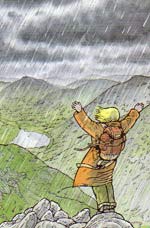 Helen Potter, the young heroine of the story, suffered incest at the hands of her father, but like many victims, she blames herself. She feels herself to be 'one bad rat', someone deserving of her father's abuse and her mother's disdain.



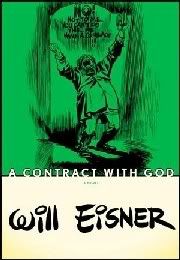 “A Contract with God” is a collection of four short stories, all set in tenement at 55 Dropsie Avenue, The Bronx, New York, somewhere in the 1930's. According to Will Eisner, the stories are semi-autobiographical - they were based on his memories of growing up in New York city at around that time, among other immigrants, many of which of Jewish origins. The stories are based both on his experiences and on those of the people who surrounded him. In the preface to this edition, he says, Call me, if you will, a graphic witness reporting on life, death, heartbreak, and the never-ending struggle to prevail...or at least to survive.