Pyongyang: A Journey in North Korea, by Guy Delisle is a graphic novel that tells the story of the author's trip to the capital of North Korea in 2001. Delisle is a French cartoonist, and was in Pyonyang working with Korean cartoonists at the time.
Delisle does a wonderful job of capturing the bizarreness of life in a totalitarian country, one that lives almost outside of the world, shut off from the west, and especially its sworn enemy, the United States. He describes a bleak, strangled society where the people live in such poverty that up to 1/3 of the population receive food from foreign aid, the average person works 6 days a week, and on the 7th 'volunteers' to do labor for the betterment of society, such tasks as picking up garbage, painting bridges, watering vast lawns with buckets of water. This is a society best described as cult-like, where the very calendar begins at the time of the glorious leader's (Kim Il Sun, Kim Jong Il's father) conception. (Wiki says the calendar starts with his birth, not conception. Not sure which is correct.)
Delisle's time away from work was spent being chaperoned around the city, as foreigners are not allowed to be in public without translators and guides who ensure they see only what they are meant to see, hear only what they are meant to hear. There is one radio station, no internet, no TV. Voices over loudspeakers blast out propaganda to encourage workers in their daily toil, everyone is required to wear pins of the glorious leader or his son, and small infractions can cause a person to 'disappear '.
I found this book to be very interesting as a glimpse into such a repressed and strange country, but there wasn't much of a story there, so I didn't enjoy it as much as I did Persepolis, which had a much more narrative quality to it. If you're interested in getting a peek into a mysterious country that very few foreigners see, I would recommend this book as an easy primer.
Though I finished my Graphic Novels Reading Challenge, I've been sucked in enough by the genre that I decided I would try a few more. From other reviews I've read on the Challenge's blog, I decided to try American Born Chinese. It is a tale of learning to accept oneself, ignoring the disparaging attitudes of those around us. Although American Born Chinese deals with the slings and arrows of racism, I would argue that the themes of acceptance and self-awareness translate well to all of us, and that anyone who has ever felt self-hatred in the face of society and its harsh criticisms can find something to identify with in this story.
The book is told in three tales. First, the ancient story of The Monkey King, who bears a strong resemblance to my personal favorite monkey, Mojo Jojo (minus the huge brain, of course). The monkey king works very hard to gain all of the attributes necessary to become a god, and attend the parties of the other gods. But he is turned away and humiliated, because underneath it all, he is fundamentally a monkey.
The second story is that of Jin Wang, an American Born Chinese boy growing up in the suburbs, attempting to distance himself from his Asian roots. He falls in love with a white girl, and wishes to be part of the popular Caucasian clique in school.
The third story is about Danny and his cousin Chin-Kee. Danny is blonde haired, blue eyed, and for some unknown reason has a Chinese cousin who comes to visit him once a year, humiliating him and making his life miserable by his hyper-stereotypical behavior, until Danny has to change schools, over and over again.
The three stories come together in an unsuspected way, and the lessons learned are lessons that are pretty much universal to the human condition.
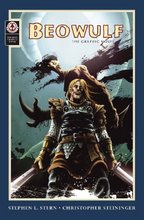
I intended to read a different version of this graphic novel, but neither my local comic book store nor my local library had it in stock, so I went along with what they had, paying careful attention to NOT get the version based on the recent film, but instead, this version based on the historic novel.
If you somehow escaped High School English without reading Beowulf, I'll get you up to speed. Beowulf is the longest surviving Anglo-Saxon poem in existence, and what a poem it is. It tells of events, both real and imagined, dated to the time of Scandinavian King Hygelac, around 450 - 600 AD. The poem itself is about 1000 years old, and current theories believe that the most recent of the ancient scribes was Christian, and probably added the more Christian aspects of the tale, such as Grendel being from the line of Cain. Beowulf has been an incredibly influential tale throughout the years, most notably influencing the 'middle earth' of J.R.R. Tolkien.
Beowulf is the story of a brave warrior, Beowulf, who is called upon to fight a monster, which has been terrorizing a small kingdom and relegating its inhabitants to a life of fear. He conquers the monster, Grendel, with his bare hands, proving his strength and cunning. He then goes on to vanquish Grendel's mother, who bears no resemblance at all to Angelina Jolie, other than her oddly large breasts and small waist (hey, this is still a genre born from comic books). Beowulf's adventures continue from there, ending with him becoming a warrior king in his own right, and eventually, his passing.
I can't say I loved this book. It was pretty much a straightforward telling of a classic tale, and I think it did a fine job at it, but thus far, I have found the more contemporary graphic novels to be much more compelling. I'll recommend it, but not with an imperative to get out and buy it now, but more of a, yeah, if you're in the mood, go for it.
My latest graphic novel was Jimmy Corrigan, or, The Smartest Boy on Earth, by Chris Ware. Initially I wasn't sure if I was going to like this book, because the illustrations are quite busy, the writing tiny and sometimes hard to read, and it looked like it might be more kid oriented than the other books I had read thus far. Boy, was I wrong. I mean, the pages ARE quite busy (see above), and the writing was sometimes difficult to read (especially when italicized), but the story itself was sad and amazing. Jimmy Corrigan is approaching middle age, and has never met his father. His life is dominated by his mother, and he both needs her and wishes she would leave him the hell alone. And the rest of the time, he is alone. He lusts in a schoolboy way over a waitress in a local coffee shop, but is too shy to talk to her. He doesn't even notice the woman who worked on the other side of his cubicle wall for 6 months. He is the epitome of emotional isolation.
The book tells the story of his meeting with his father, which is mostly a dud. His dad is a bombastic blow hard, who tells inappropriate stories and gets excessively angry with a waitress who messes up his order...and Jimmy is passive enough to go fix the order with the waitress, but then ends up paying for the fixed burger, when it was the waitresses fault to begin with. The story weaves between the past, the distant past (the tragic story of Jimmy's grandfather's youth with an abusive father), and fantasies of being a superhero, a robot, anything.
Jimmy's coping mechanisms are heart-breaking, but his grandpa's story was the one that made me cringe inside. There's a scene where he goes to an immigrant friend's house with a group of kids, to make figurines out of clay or something, and the grandpa (also named Jimmy) waits and waits for the friend's father to irrationally lose his temper, to curse and yell and explode in his anger. When that doesn't happen, when the man shows actual warmth toward the kids, and praises Jimmy's horse figurine, Jimmy attaches himself to the man, and starts to fantasize about staying there forever. Of course, his father comes and drags him home, with him crying the whole time. Ugh.
Not an easy read on the eyes or the heart, but a touching and brilliant peek into the inner workings of an emotionally stunted character. Highly recommended, again. I might have to give a few more graphic novels a shot, I'm thinking.
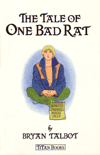
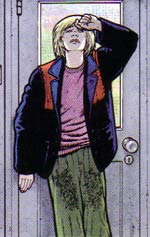
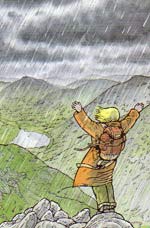
The Tale of One Bad Rat, by Bryan Talbot, is a pretty amazing accomplishment. Mr. Talbot started out with the goal of writing a graphic novel that took place, at least partially, in the Lake District of England, home of Beatrix Potter and the characters of her children's books. From that beginning, he took the image of a young homeless girl being harassed by a bearded 'Jesus Freak', (his words) in the Tube, and constructed a tale around her. For the girl to be homeless, Mr. Talbot decides that she needs a reason to have left home. So his character is the victim of sexual abuse by her father, and neglect and uncaring by her mother. Left to many authors, this story might have been heavy handed, but Mr. Talbot clearly put a lot of time and work into researching the mental effects of incest upon children, and he brings his young protagonist on a touching journey from the streets of London to the English Countryside, where she seeks solace in the familiar surroundings of her favorite childhood books, those of Beatrix Potter.
Helen Potter, the young heroine of the story, suffered incest at the hands of her father, but like many victims, she blames herself. She feels herself to be 'one bad rat', someone deserving of her father's abuse and her mother's disdain.
The first part of the book tells of Helen's experiences in London, both good and bad. The book opens with Helen in the Tube, fantasizing about killing herself. We also meet her only friend, a little rat named 'Ratface'. Ratface is with her throughout the book, sometimes in reality, sometimes in her imagination, but he is her constant companion, and her conversations with him provide a peek into her inner dialog. She is befriended by some thieves, who rescue her from the creepy clutches of a man on the street (who they then rob). She stays in an abandoned house with the thieves for a month or so, but things there go wrong, and she moves on, deciding to find her way out into the country, to the home of Beatrix Potter.
The story of her abuse is seen in flashbacks, which aren't gruesome, but are guaranteed to make your heart ache for Helen. When she finally arrives in the Lake District, she is taken in by some friendly innkeepers, and through their acceptance and the peace of the area, she is able to finally understand that she did nothing to deserve the treatment she received, and she is able to confront her father. The freedom she feels after confronting him is a beautiful thing, and she is finally able to move on in her life.
I really loved this book...I checked it out from the library, and I may decide that I need to own a copy. The author took such a difficult, heartbreaking subject, and with his beautiful drawings and sensitive touch, made it a story of redemption and the power of believing in ones self. Highly recommended.
Persepolis is a story told in two graphic novels, The Story of a Childhood, and The Story of a Return. It is also the name of an award winning animated film based on these graphic novels. The stories are the autobiography of Marjane Satrapi, a woman born in Iran in 1969, and they follow her through his overthrow, and give voice to the crushed hopes of the Iranian populace when things go from bad to worse under the fundamentalist rule of the Ayatollah.
Marji's family is very progressive and open minded, and they encourage her to be a free thinker, to read and understand the events going on around her. They participate in demonstrations against the Shah, and then in demonstrations against the Ayatollah, wanting desperately to bring Persia back to the cultural haven it once was. Watching the news today, of course, you wouldn't know that modern Iran was once a bastion for intellectuals and free thinkers, for artists and authors and architects. We only see little snippets of life in Iran, and that is of the extreme fundamentalist regime currently in power. The impression is that all of the free-thinkers left Iran during the revolution, to escape the Ayatollah and his rigid and intolerant policies. Reading books like Persepolis, or Reading Lolita in Tehran, one sees the cultural underground that is still very much alive and well in Iran.
But I digress. Back to Persepolis. The first book tells the story of her childhood in Tehran, of the oppression felt by the Iranians under their government, of the relatives and friends who suffered torture and death for their beliefs. If you don't know much of the history of Tehran, it is a fairly simple account of events, yet it packs an emotional punch. At the end of the story, Marji's parents decide to send her to Austria, where she will not be punished for her outspoken ways, where her spirit will not be suppressed by the crushing regulations imposed on citizens, most extremely upon women and girls. The last page of the novel is heartbreaking, Marji at the airport, watching in horror as her parents leave, her mother in her father's arms, because she has fainted in grief and fear for her daughter.
The second novel tells of her time in Austria, as well as her return to Tehran. There, she feels like an outsider, like an immigrant who will never fit in. She finds a group of anarchists to hang out with, maintains her ability to get in trouble, and never stops missing her family and her homeland. After a few months living on the streets, she returns home to Iran, where the crushing oppression of the regime, and her inability to cope with it, send her into a depression. Eventually she overcomes her depression, goes back to school, finds love, and finally, herself. The final page of the novel mirrors the first, with her again leaving her family behind, this time as an adult, leaving for Paris, where she hopes to write and draw for a living.
The stories are so well told, I was engrossed from the first page. Marji is the kind of kid we would all want, though she doesn't recognize that in herself. Her parents see a curious mind, a keen sense of humor, and an indefatigable spirit. She sees a slacker who spends weeks at a time stoned and checked out of society. Even if they had known of her drug use in Austria, however, I suspect that they would have not thought her any less the perfect child...they would see this as a mistake, and mistakes are how we learn. And learn she does, painful lesson by painful lesson.
It's hard not to like a kid who remembers how to defend herself. Though her parents sent her to live with a friend, that friend promptly left her off at a Catholic school, to be taught by nuns. When left behind at school during the holidays, when all of her schoolmates are free to go home to their families, and she is left behind with the nuns. She comes down to the TV room with a pot of pasta to eat (she was too hungry for one serving, so brought more so she could enjoy it while watching TV), and is reprimanded by one of the Sisters for her gluttony. The nun says, "It's true what they say about Iranians, they have no education." Marji, her blood boiling, retorts, "It's true what they say about you, too. You were all prostitutes before becoming nuns!" Go, Marji.
I really liked these novels. Give them a try, or, perhaps the movie, which looks to be fairly similar, though the white subtitles on a white background make me wish I spoke French.
* *click picture to enlarge I Killed Adolf Hitler, by Jason, is my first book for the Graphic Novels Challenge (links to my list on my blog). I've never tried graphic novels before, and haven't been a huge fan of comic books since my days of Betty and Veronica, with the exception of the Buffy, Season 8 comics, which is more about needing more Buffy, less about the genre. So here I find myself treading into a new medium, where an entire book can be read during lunch, and more is said in pictures than in words. The example I chose for a graphic, I suppose, isn't a good one to show this, since most of the frames contain words, but there are pages in the book that don't contain any. Pages where the deadpan expressions of the characters say more than pages of words could say.
In I Killed Adolf Hitler we find a world where hiring someone to kill your neighbor because they play their music too loud is perfectly legal. Where there doesn't seem to be much joy. The protagonist is sent back in time by a scientist to, you guessed it, kill Adolf Hitler before he comes to power, thus preventing the rise of World War II, and making the world a better place. He goes back, shoots Adolf, but then things go awry. I won't ruin it for you by telling you more, but I'll tease you by saying that there's a kinda sweet little love story in there about the protagonist and his girlfriend, and what they find out about themselves and each other in the process of trying to correct history.
My blog is Thinking About..., and I go by 'J'. I'm here to confess that I've never read a graphic novel, and haven't had much interest in them. But there's a film out right now, Persepolis, which the review in our newspaper said is so much like the graphic novel, you get pretty much the same experience by reading the book that you do watching the film. That kind of intruigued, me, and then I saw this challenge on Dewey's blog, so I decided to give it a shot. I'll try to see what this genre is about, and if I can get into it, and I'll read 6 graphic novels in 2008. Here are my choices, not particularly in any order:
I Killed Adolf Hitler, by Jason A contract killer goes back in time to kill Hitler...and fails spectacularly. Recommended by Dewey herself.
Jimmy Corrigan: Or, the Smartest Kid on Earth, by Chris Ware Ware's book is a semi-autobiographical account of his first contact with the father who abandoned his family. I get the feeling it didn't go very well.
Beowulf, by Gareth Hinds I read Beowulf in High School, and talk about your epic tales! This is not like the recent movie version, I hope, but I'll let you know after I finish.
Persepolis: The Story of a Childhood, by Marjane Satrapi This is the story that sucked me into this challenge, so you know I'm looking forward to reading this one. :)
Persepolis 2: The Story of a Return, by Marjane Satrapi This is the continuation of Persepolis. The two stories together are about a young Iranian girl, whose family decides to stay in Iran after the revolution, but as she is not the kind of quiet, unassuming girl that can assimilate easily into society under the new regime, they decide to send her away to Europe for her own safety. The Story of a Return, I can only assume, is about her experiences when she is grown, and returns to Iran.
The Tale of One Bad Rat, by Bryan Talbot This one is another that I found on Dewey's site, and it looks really interesting. It's the story of a girl, Helen, who is a runaway, and I think the victim of sexual abuse. The drawings are in the tradition of Beatrix Potter, and the character is named Helen Potter. I don't want to read more about it until I actually read it, so you'll have to wait and see what I have to say.

 I intended to read

 From that beginning, he took the image of a young homeless girl being harassed by a bearded 'Jesus Freak', (his words) in the Tube, and constructed a tale around her. For the girl to be homeless, Mr. Talbot decides that she needs a reason to have left home. So his character is the victim of sexual abuse by her father, and neglect and uncaring by her mother. Left to many authors, this story might have been heavy handed, but Mr. Talbot clearly put a lot of time and work into researching the mental effects of incest upon children, and he brings his young protagonist on a touching journey from the streets of London to the English Countryside, where she seeks solace in the familiar surroundings of her favorite childhood books, those of Beatrix Potter.
 Helen Potter, the young heroine of the story, suffered incest at the hands of her father, but like many victims, she blames herself. She feels herself to be 'one bad rat', someone deserving of her father's abuse and her mother's disdain.