
Martin, Ann. 2006. The Babysitter's Club. Graphics by Raina Telgemeier.
The Babysitters Club. I admit it. I read them as a child. I can't say I read all 131 books and 12 Super Specials, but I read more than a few. I believe I grew out of them by the early to mid-thirties. (Not my age. The number in the series.) The first book in the series, Kristy's Great Idea, was published in August of 1986. When I discovered the series, the first three or four were already published. I believe I bought them all at the same time. (I think. It's been a while. But I do remember that I had to wait after that for each new release.) Why the emphasis on how old it is? Because it says something both about the book and about me. The graphic novel--for me--just didn't do this book justice. I'm biased. I'm not really "into" graphic novels. I'm not. I've read most of the Babymouse and I love them. I do. But that is really the exception. The others? I look at the covers. I might open one now and then. But overall, I'm just not that interested. Why did I pick this one up? The Young Adult Reading challenge (host Shady Glade) has a requirement of a graphic novel. And I wanted to reread Kristy's Great Idea for the Heart of A Child challenge. (And the actual novel-novel was checked out.)
For those who haven't read any of the novels and have no idea what's going on (if you're patient enough to get this far), The Babysitters Club is started by Kristy. It is her "great idea." She teams up with some of her closest friends, Claudia and Mary Anne, and invites a new girl into the club as well, Stacey. The Club is to help parents find a babysitter in one quick and easy call. One call, 4 sitters at their disposal. The series alternates narrators between each member of the club. (And more than four do eventually join.)
I haven't read the book in at least fifteen years. But a lot has changed in fifteen years. The book has no computers, no internet, no email, no cell phones. And things like nail polish and make-up are "forbidden" to girls their age (seventh grade, I believe) and having a phone in one's bedroom (or one's own phone line in general) is a complete novelty. Claudia's extra-extra cool because she does. But the references to Rainbow Brite and G.I. Joe date the novel further. (While you could argue that G.I. Joe is relatively timeless, they're certainly not the HUGE thing they were in 1986. I remember watching the end credits to the cartoon show every week day. I was always early for the next show. Now I can't quite remember what that show was.)
I don't know if the lack of technology would bother modern readers or not. But not having it certainly makes starting the club more work for the kids. And that's not necessarily a bad thing. It gets them thinking; it gets them into being creative.
There is more than just babysitting involved as well. The big "issues" of the book being Kristy dealing with her parent's divorce and her mother's dating again and Stacey's issues with coming clean about her diabetes to her friends. (Claudia's issues are with her parents not wanting her to wear make-up. Mary Anne's issues are with her father's strictness in general.)
I was surprised by how much I remembered. The small things. The little details. The snippets of dialogue. Each character's pet peeves. The mundaneness of siblings' names even. This is neither a good or bad thing. Just something to think about. I wonder how much essentially useless knowledge is stored in my brain???
Monday, June 16, 2008
Kristy's Great Idea

Romeo & Juliet

Manga Shakespeare: Romeo & Juliet. Originally published in UK. Illustrated by Sonia Leong.
I'll be honest with you from the start, I have zero experience with Manga. The drawing factor for me wasn't the Manga--it was the Shakespeare. I like anything (and everything) that makes Shakespeare accessible for readers. That essentially translates into me liking Manga Shakespeare: Romeo and Juliet. I'm not sure how typical or untypical Manga Shakespeare compares to other Manga out there--as far as text or graphics or design goes. So I'm just gonna leave it for others to decide.
Open up Manga Shakespeare and what do you find? "Present day Tokyo. Two teenagers, Romeo and Juliet, fall in love. But their rival Yakuza families are at war." That makes it appear--at first glance--like they've changed Shakespeare, doesn't it? That the text is going to be really off base. But while the illustrations follow that story, the text is about as true to the bard as you can get. It does take some getting used to (for me and maybe only me) to realize that the text and the illustrations aren't really in sync with one another. The graphics show people emailing and texting and using cell phones and what not, but the text is true to the original. (That doesn't mean it's line for line, word for word, unabridged and unadapted, but it's close enough that dare I say it--you could probably maybe get away with reading this instead. As long as you don't give yourself away by saying it's set in Tokyo and that it was Romeo's lack of signal on his cell phone that led to the tragic deaths of two young lovers. (His cell phone was "no signal" and he missed the message that Juliet was faking her death.)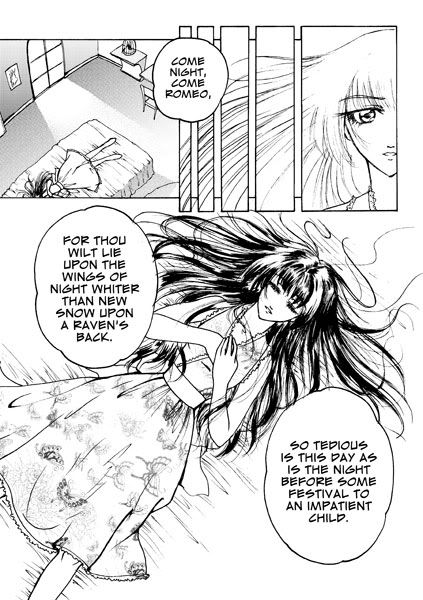
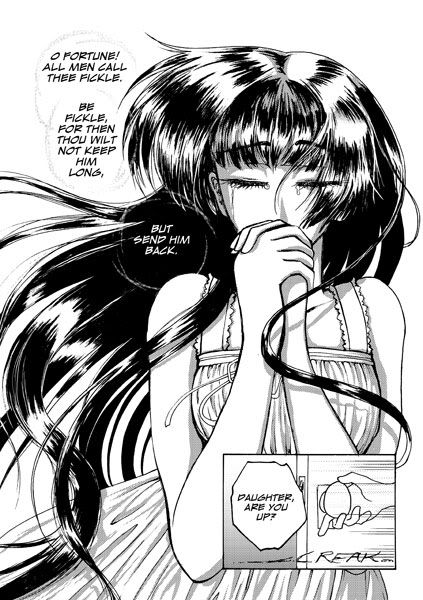 At first, I thought that I would have a hard time following the story. It's not that I'm UNfamiliar with the original. I've read it at least three times. It's just that with graphic novels, I don't always recognize who everyone is supposed to be. Small details--color and length of hair, shapes of eyes, small fashion details that distinguish characters from one another--can be hard to pick up if you're graphically challenged. Call me a newbie. But surprisingly enough, I soon had it down. Part of me wishes that it had all been in color. But I don't know the rules of Manga--if it's mainly black and white or if it's mainly color, or if just depends. That's why I'm not going to try to sound like I know what I'm talking about here.
The only other slight issue I had with the book is the fact that for a few pages, the characters shrunk. I don't know if that's the best description. I think the best word would be everyone and everything became squatty. They became instead of tall and lean and normal, they became short and fat and stocky and odd. I don't know if this is typical or not. It could be. But it was just weird for me.
I did think the format worked well. It definitely made Shakespeare more reader-friendly. The good stuff was kept sacred, and you'll probably recognize most of the quotes. That is if you're familiar with the play or with the movies that stayed true to the play or if you've watched Shakespeare in Love repeatedly. (Not that I'm judging!)
You can read more about the series here.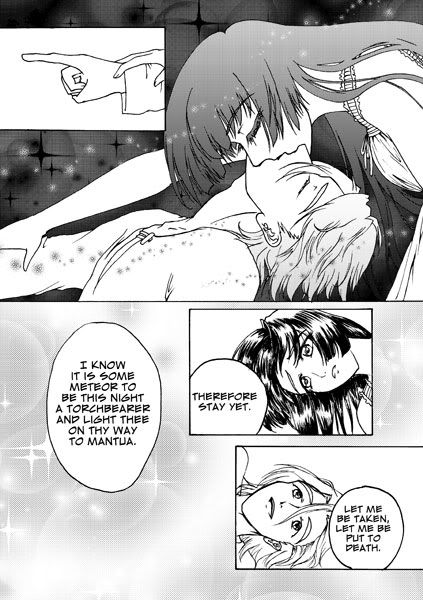
JULIET
Wilt thou be gone? it is not yet near day:
It was the nightingale, and not the lark,
That pierced the fearful hollow of thine ear;
Nightly she sings on yon pomegranate-tree:
Believe me, love, it was the nightingale.
ROMEO
It was the lark, the herald of the morn,
No nightingale: look, love, what envious streaks
Do lace the severing clouds in yonder east:
Night's candles are burnt out, and jocund day
Stands tiptoe on the misty mountain tops.
I must be gone and live, or stay and die.
JULIET
Yon light is not day-light, I know it, I:
It is some meteor that the sun exhales,
To be to thee this night a torch-bearer,
And light thee on thy way to Mantua:
Therefore stay yet; thou need'st not to be gone.
ROMEO
Let me be ta'en, let me be put to death;
I am content, so thou wilt have it so.
I'll say yon grey is not the morning's eye,
'Tis but the pale reflex of Cynthia's brow;
Nor that is not the lark, whose notes do beat
The vaulty heaven so high above our heads:
I have more care to stay than will to go:
Come, death, and welcome! Juliet wills it so.
How is't, my soul? let's talk; it is not day.
JULIET
It is, it is: hie hence, be gone, away!
It is the lark that sings so out of tune,
Straining harsh discords and unpleasing sharps.
Some say the lark makes sweet division;
This doth not so, for she divideth us:
Some say the lark and loathed toad change eyes,
O, now I would they had changed voices too!
Since arm from arm that voice doth us affray,
Hunting thee hence with hunt's-up to the day,
O, now be gone; more light and light it grows.
ROMEO
More light and light; more dark and dark our woes!
Now on to the story itself. Call me contrary, but Romeo & Juliet just doesn't do it for me. I don't see Romeo & Juliet as this marvelously romantic couple. I think Romeo is as silly as silly can be. I can't judge Juliet's heart as easily. But Romeo? How can I trust a guy who can be head-over-heels madly, deeply, truly in love with a girl one minute, to the point of depression and distraction and good old-fashioned moodiness, and then at the drop of a hat, in just one glance fall madly, truly, deeply, head-over-heels in love with another girl having completely forgotten his former love and heart's desire. Romantic? I think not. Add in the fact that these young lovers--at least Juliet is, I'm not sure of Romeo's exact age--are way too young to even think about making life-time commitments. (She's either 13 or 14.) The fact that this was considered marriageable is a bit stomach-turning to me. When you think about it, their bodies, their minds, their souls are just beginning to develop. They're still growing and changing. True love? Probably not.... Textbook case of stupidity of both teens and adults? Definitely! It's hard to find a character that isn't stupid in Romeo & Juliet. The parents of each child? Stupid! The friends of both families with their I-must-fight-for-the-fun-of-it attitude? Stupid! The fact that people were being killed just for the thrill of it? for the sake of some stupid family feud? Beyond stupid.
So the text is beautiful. I won't deny that. But the motivation that leads to this tragedy is just plain old-fashioned stupidity only romanticized and idolized to last forever and ever and ever.
© Becky Laney of Becky's Book Reviews
Midsummer Night's Dream
 Manga Shakespeare: A Midsummer Night's Dream. Illustrated by Kate Brown. 2008.
Last Wednesday, I reviewed Manga Shakespeare's Romeo & Juliet. I liked it. I did. As much as I ever could like Romeo & Juliet anyway. This week, I'm happy to be reviewing Manga Shakespeare's A Midsummer Night's Dream. This has always been more of a favorite of mine. Not my absolute favorite Shakespeare mind you, but near the top at least where comedies are concerned. There is a certain playfulness, a whimsical flavor that is light and fun and more joyous. Love isn't deadly in A Midsummer Night's Dream. It's playful, fun, silly, fickle, whimsical. It's the anti-Romeo-and-Juliet play.
A Midsummer Night's Dream is the story of multiple lovers, multiple couples. There isn't one main story--there are many teeny-tiny stories that are all woven together into a delightful mix. There is Oberon and Titania, Theseus and Hippolyta, Hermia and Lysander, and Helena and Demetrius. And then there is the playful mixing of Lysander and Helena and Titania and Nick Bottom (the Ass of a man). There is much angst in A Midsummer Night's Dream. Much. Angst. You've got father-daughter conflict. You've got thwarted, forbidden love. You've got unrequited love. You've got secrets. You've got betrayals. You've got angry little spats. And at the heart of the whole mess is Puck. Puck is such a wonderful and delightful little fairy-type character. He is a prankster. Someone who takes enjoyment out of playing and interfering with mortals.
In Romeo-and-Juliet, love is taken too seriously. Here, one might argue that love isn't taken seriously enough. You've got these two men, Lysander and Demetrius, making all sorts of foolish speeches...but the reader is in on the inside joke this time around. The reader knows that all this talk of love is just foolish magic-talk. The reader knows that such talk isn't to be taken at face-value. Each of our characters is flawed. There isn't one among them that doesn't have something that keeps them just short of perfection.


Helena, lovable though she may be, is a bit too clingy, a bit too desperate, a bit too go-getter. As a modern reader, you want to tell her to show some pride, hold on to some dignity, to not be so obviously lovesick. And, Demetrius, well, he seems a bit too full of himself. Although the text doesn't necessarily come right out and say it, he comes across to this reader as thinking he's God's gift to women. In other words, he needs a comeuppance, to be put into his place. The work of Puck on Demetrius can only be a good thing that we hope can last. Oberon, same thing, he's arrogant; he's proud; he's got this whole domination thing going on...but I can't really dislike the guy because he has a heart when it comes to Helena. He sees the poor girl in need and sets out to help her. It's not his fault Puck helps a little too much.
The language, the style. It's Shakespeare. It's beautiful. It's memorable. It just works. Again, there is nice adaptation in this Manga edition.
The artwork. I love the colored illustrations of the beginning. But there were certain sequences that just didn't work for me with this one. I liked certain pages, certain spreads. But I can't really say that the ENTIRE book was utterly fantastic or anything. But look at this color spread? Isn't it wonderful?
***
TITANIA
My Oberon! what visions have I seen!
Methought I was enamour'd of an ass.
***
THESEUS
I pray you all, stand up.LYSANDER
I know you two are rival enemies:
How comes this gentle concord in the world,
That hatred is so far from jealousy,
To sleep by hate, and fear no enmity?
My lord, I shall reply amazedly,EGEUS
Half sleep, half waking: but as yet, I swear,
I cannot truly say how I came here;
But, as I think,--for truly would I speak,
And now do I bethink me, so it is,--
I came with Hermia hither: our intent
Was to be gone from Athens, where we might,
Without the peril of the Athenian law.
Enough, enough, my lord; you have enough:DEMETRIUS
I beg the law, the law, upon his head.
They would have stolen away; they would, Demetrius,
Thereby to have defeated you and me,
You of your wife and me of my consent,
Of my consent that she should be your wife.
My lord, fair Helen told me of their stealth,THESEUS
Of this their purpose hither to this wood;
And I in fury hither follow'd them,
Fair Helena in fancy following me.
But, my good lord, I wot not by what power,--
But by some power it is,--my love to Hermia,
Melted as the snow, seems to me now
As the remembrance of an idle gaud
Which in my childhood I did dote upon;
And all the faith, the virtue of my heart,
The object and the pleasure of mine eye,
Is only Helena. To her, my lord,
Was I betroth'd ere I saw Hermia:
But, like in sickness, did I loathe this food;
But, as in health, come to my natural taste,
Now I do wish it, love it, long for it,
And will for evermore be true to it.
Fair lovers, you are fortunately met:
Of this discourse we more will hear anon.
Egeus, I will overbear your will;
For in the temple by and by with us
These couples shall eternally be knit:
And, for the morning now is something worn,
Our purposed hunting shall be set aside.
Away with us to Athens; three and three,
We'll hold a feast in great solemnity.
Come, Hippolyta.
***
THESEUS
[Reads] 'The battle with the Centaurs, to be sung
By an Athenian eunuch to the harp.'
We'll none of that: that have I told my love,
In glory of my kinsman Hercules.
Reads
'The riot of the tipsy Bacchanals,Tearing the Thracian singer in their rage.'
That is an old device; and it was play'd
When I from Thebes came last a conqueror.
Reads
'The thrice three Muses mourning for the deathOf Learning, late deceased in beggary.'
That is some satire, keen and critical,
Not sorting with a nuptial ceremony.
Reads
'A tedious brief scene of young PyramusAnd his love Thisbe; very tragical mirth.'
Merry and tragical! tedious and brief!
That is, hot ice and wondrous strange snow.
How shall we find the concord of this discord?
PHILOSTRATE
A play there is, my lord, some ten words long,
Which is as brief as I have known a play;
But by ten words, my lord, it is too long,
Which makes it tedious; for in all the play
There is not one word apt, one player fitted:
And tragical, my noble lord, it is;
For Pyramus therein doth kill himself.
Which, when I saw rehearsed, I must confess,
Made mine eyes water; but more merry tears
The passion of loud laughter never shed.
***
THESEUS
No epilogue, I pray you; for your play needs no
excuse. Never excuse; for when the players are all
dead, there needs none to be blamed.
***
PUCK
If we shadows have offended,
Think but this, and all is mended,
That you have but slumber'd here
While these visions did appear.
And this weak and idle theme,
No more yielding but a dream,
Gentles, do not reprehend:
if you pardon, we will mend:
And, as I am an honest Puck,
If we have unearned luck
Now to 'scape the serpent's tongue,
We will make amends ere long;
Else the Puck a liar call;
So, good night unto you all.
Give me your hands, if we be friends,
And Robin shall restore amends.
© Becky Laney of Becky's Book Reviews
Hamlet

Manga Shakespeare: Hamlet. Illustrated by Emma Vieceli.
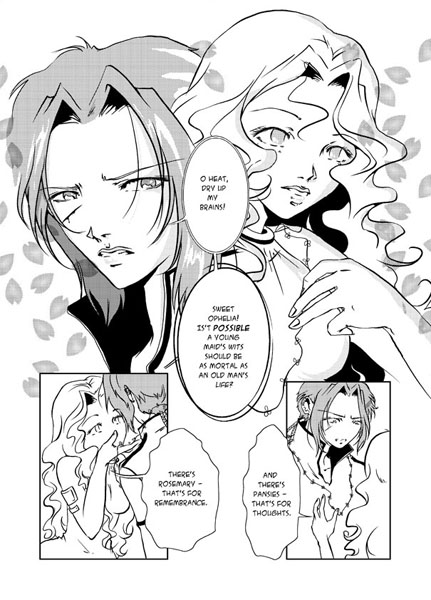
"The year is 2107 Global climate change has devastated the Earth. This is now a cyberworld in constant dread of war. Prince Hamlet of Denmark has come home to face an uncertain future."
The above gives you a clue about the illustrations that follow in Manga Shakespeare's take on Hamlet. (I suppose. I have a hard time deciphering just what it's supposed to mean. What is a cyberworld?) As in previous titles, however, the text remains true to the spirit and times of Shakespeare. Hamlet, unlike Romeo & Juliet and A Midsummer Night's Dream, is not a love story. Rather, it's quite the opposite. It's the story of hate, of revenge, of anger, of bitterness. A young man, Hamlet, returns home to find his father dead--murdered--and his mother married to his uncle, his father's murderer. He's angry and rightly so. The ghost of Hamlet's father inspiring him to take vengeance, Hamlet sets in motion a violent and disturbing plot. I don't suppose Hamlet meant to litter the stage with dead bodies. I believe he only intended to take the life of his uncle, his stepfather, Claudius. But things don't always go according to plan. And Hamlet is indeed a tragedy. Do two wrongs make a right? Well, no, they don't. The death of all these characters--Claudius, Gertrude, Polonius, Laertes, Hamlet, Ophelia--can never make the death of the king, Hamlet's father, okay. All those deaths don't make reparation. No matter how many dead bodies pile up...
© Becky Laney of Becky's Book Reviews
Walking Distance

Rod Serling's The Twilight Zone: Walking Distance. Adapted by Mark Kneece. Illustrated by Dove McHargue
Coming in October 2008, a graphic novel series inspired by classic Twilight Zone episodes. Up first? Walking Distance and The After Hours. I'll review each separately.
You're traveling through another dimension, a dimension not only of sight and sound but of mind; a journey into a wondrous land whose boundaries are that of imagination. That's the signpost up ahead--your next stop, the Twilight Zone.
Walking Distance is the story of a world-weary man, Martin Sloan, who stumbles into his hometown, Homewood, and meets his young and carefree self. Emboldened by the idea of saving himself from a life of drudgery, Martin tries to pass along some words of wisdom to his eleven-year-old self. What would you say to a younger you? If you could go back in time and *warn* yourself about the future? Would you listen to yourself? Walking Distance is an interesting premise. Martin learns, as we all must, that you can't change the past. You can't cling to the past. There's no use wondering about the what-ifs...I like the fact that it is his father who is sharing his words of wisdom with his all-grown-up son, "When you go back--look ahead. You've got to be strong that way. Life only looks complicated. It takes strength to keep it simple. Don't long for the past."
One of the reasons I like this story is that it illustrates a longing, a wishing we have to connect. Maybe we wish we could have a conversation with a parent, with a child, or even with ourselves--younger or older. When Martin *accidentally* goes back in time, he sees his hometown exactly as it was. He sees his friends, his neighbors, his parents, and, of course, himself. And on some level, I think this idea appeals to us. Especially tied in with this is the theme of loss. The past is lost to him, of course, except in his mind. But also the loss of his family. (I'm not sure if the text mentioned his mother, but I think they mentioned that his father had died. Martin is given the opportunity of perhaps *listening* to his father's words of wisdom for the first time.)
© Becky Laney of Becky's Book Reviews
The After Hours

Rod Serling's The Twilight Zone: The After Hours. Adapted by Mark Kneece. Illustrated by Rebekah Isaacs.
I hope I'm not the only one excited about this new series of graphic novels inspired by classic episodes of Rod Serling's The Twilight Zone. The first two books in the series are being released in October 2008. More will follow! (I'll post about that at the end!)
The After Hours is a classic for a reason. It's about a "customer" at a department store that has quite a unique experience. I remember watching this episode as a kid. I remember being freaked out by it. But my love of Twilight Zone was always there--freaked out or not.
You're traveling through another dimension, a dimension not only of sight and sound but of mind; a journey into a wondrous land whose boundaries are that of imagination. That's the signpost up ahead--your next stop, the Twilight Zone.
 Marsha White entered the department store in search of a gold thimble to buy her mother. But not all is at appears. First, she's taken by special elevator up to the eighteenth floor. Here she sees an entire floor of a department store empty but for one store clerk, a woman, and one gold thimble. Making her purchase, too hastily perhaps, she returns to the main floor of the store where she discovers a flaw in the thimble. But her complaints are met strangely. The men in charge seem emphatic that there is no eighteenth floor. Also they don't carry gold thimbles either. After a slight accident, a trip or fall perhaps, Marsha wakes up in one of the offices later that night. Her adventures in the store after hours...well...I won't spoil all here.
I definitely enjoyed this one, and would definitely recommend it!
Here is what I was able to learn from my googling:
Fall 2008
"Walking Distance"
"The After Hours"
Winter 2009
"The Monsters are Due on Maple Street"
"The Odyssey of Flight 33"
Spring 2009
"Deaths-head Revisited"
"The Midnight Sun"
Fall 2009
"The Big Tall Wish"
"Will the Real Martian Please Stand Up?"
© Becky Laney of Becky's Book Reviews
