Showing posts with label Dewey. Show all posts

Tuesday, July 8, 2008

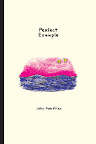
Perfect Example by John Porcellino

Perfect Example is a coming-of-age story, a sort of memoir told in comics, or perhaps an autobiographical graphic novel. It depicts Porcellino's summer after high school graduation. It was especially poignant for me, because I grew up in the same time and place as Porcellino -- not the exact suburb, but very nearby. The places the characters visit, the music they listen to, the types of houses they live in, even the basic attitudes of the teens and parents, all of these were very familiar to me.

The summer after high school is often a time of trying to figure out one's place in the world. Porcellino portrays his adolescent-on-the-brink-of-adulthood self trying to find a balance between getting to know himself as an individual and finding a way to feel less isolated. This book also manages perfectly capture avoidance as a way of dealing with the realization that you've attained a major milestone in life without a clue about what comes next for you. Sometimes the teenage John seems to be working hard at staying a kid, doing kid things with his friends, and other times, confronted by those same friends with the need to make decisions about college and adulthood, he sinks into depression. The words, "I don't know" appear over and over throughout the story, and John is often completely paralyzed with indecision, even about small things such as whether or not it's ok to try to hold the hand of a girl he likes.

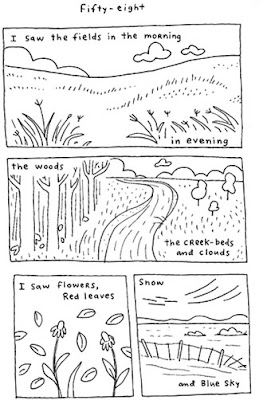
You can see an example of Porcellino's simple line drawings below.

Monday, June 9, 2008

American Born Chinese by Gene Luen Yang

American Born Chinese was the 2007 Printz Award winner. It was also a finalist for the 2006 National Book Award. I'm thrilled that a graphic novel was recognized by the people behind these prestigious awards. Readers of all sorts are really beginning to see the literary value of stories told with both words and pictures.

This book addresses a variety of important themes, but I think the most important is that of identity: how we let others influence how we see ourselves; the sides of ourselves we may be unaware of; how often we base our own identities on what we aren't rather than what we are; how damaging our treatment of people based on ignorant perceptions can be to their identities; how inner strength and authenticity can be achieved, and so on. I think I could read this book every day for the next month and keep finding more ideas about identity within it. It's a very skillfully layered book.

It begins with three separate stories which are told in alternating chapters, though these stories eventually converge, and the connection between them is revealed.

The first story is a traditional folk tale of a monkey king. He attends a party with other gods, but is turned away because he's a monkey and wears no shoes. The image below features the monkey king working on attaining the four major disciplines of invulnerability.


A second story is about Jin Wang, a Chinese-American boy who is navigating between the predominantly-white world of his school and the world of his parents, who live a more traditionally Chinese lifestyle at home. The image below demonstrates the ways in which even well-meaning people who attempt to be accepting of diversity can hurt individuals with carelessness or ignorance.


In the bottom right hand corner, you see one of Jin's classmates, a Japanese-American girl the bullies in the class call "chink," which is a demeaning term for a Chinese person, not a Japanese person. The ignorance of some of Jin's classmates is so deep that they can't even get their racial slurs right. If you're a woman like me, you may have been called names usually reserved for women. That's pretty horrible, but imagine if the people degrading you with words paid so little notice to who you really are that they didn't even use ugly words reserved for females, but instead called you names commonly used to insult men. With the former names, as awful as they are, you at least know that you're not alone, that other women are called these names. With the latter, your femaleness is completely dismissed. Imagine how much damage something like that, happening day after day to a child, could do. How would that affect your sense of who you are?

The third story features Chin-Kee, a horrifyingly stereotypical Chinese boy who visits his white American cousin, embarrassing that cousin with his stereotyped behavior: eating "clispy flied cat noodles" in the cafeteria, knowing the answers to all questions in class, etc. This story evokes a TV sitcom, with a laugh track running at the bottom of many frames. Just like in real sitcoms, he laugh track is often there when nothing even remotely funny has happened, which is one reason I refuse, under any circumstances, to watch any TV show with a laugh track. Below, you see Chin-Kee and his cousin, Danny, or as Chin-Kee says, Da-Nee.


This is the sort of book that would appeal to teens struggling with their own identities, but if I gave this book to my own teen, I'd probably discuss it with him afterwards. Sometimes kids are so surrounded by stereotypes that they don't recognize when they're used as satire.

And, of course, this book would also appeal to a wide variety of adults. I adored it, myself. Nymeth thought highly of it, as did Alison.

Thanks to Alison for this link to an essay by Yang about how he came to write this book.
Thursday, June 5, 2008

We Are On Our Own by Miriam Katin

This is an amazing book. I suggest you all run straight out to your library or bookstore now and pick it up. Seriously.
We Are On Our Own is a memoir in the form of a graphic novel, a genre I've seen called graphic memoirs, visual autobiographies, and even autobifictionalography, among others.

It's a very dark, serious book about Katin's childhood as a Jew in Hungary during World War II. Her father was off fighting, and she was at home with her mother. When her mother received papers telling her to put all her belongings in storage and report for deportation (or hopefully "only" deportation), her apparently wealthy mother obtains fake papers and takes Katin off to make a living sewing in a small village. They live on the run, in hiding, for a while, and when the war is over wait to find out whether Katin's father is still alive.

The story is told from the point of view of Katin, who seems about four or five years old at the time in which the book is set, which provides the sort of details not usually found in stories of the Holocaust. There were so many horrors, I think, that people who were adults at the time generally don't remember some of the smaller tragedies, or at least don't think to tell them. But since Katin was a child, she remembers things like the loss of her dog. The first indication we have that Katin is living during war time, and maybe her first memory of the war, is when her mother is forced to turn in Katin's dog to the Nazi's.

In addition, since this is Katin's story and Katin was with her mother, we see the war from a woman's perspective. This is not something that is available that often, women's war stories. All the more reason this book is an absolute treasure.

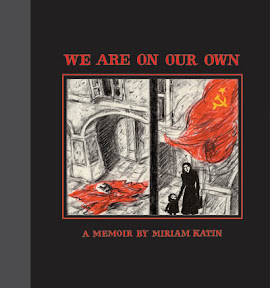
In the cover image above, you can get a sense of Katin's drawing style. The color in the flags is a rare addition; inside, most of the drawings are dark pencil sketches, with beautiful impressionist-like color sketches saved for scenes of pre-war and post-war times.

Tuesday, June 3, 2008

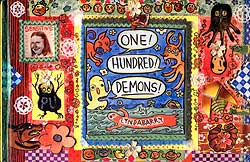
One Hundred Demons by Lynda Barry

I really loved One Hundred Demons. It's a very unique book, and I'm not quite sure how to go about describing it, except with words like awesome or delightful. It's not quite a graphic novel, though the stories are interwoven. Barry calls herself a cartoonist, though to me, cartoons are animated and comics are on paper. She calls this book "autobifictionalography" because parts of it are true and parts are made up. I think that like many storytellers, she embellishes where it's necessary to make the story more fun. The book is full of pop-culture references from the time she was growing up (she was born in 1956), quite a few of which I caught. If you were born in the fifties, you'll probably catch even more, maybe all of them.

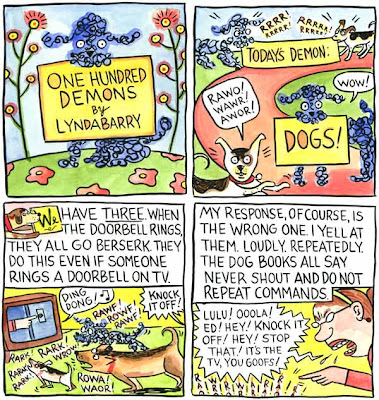
The book started out as a painting exercise. She read about a monk who painted a hundred demons on a handscroll in 16th century Japan and decided to try the project herself. The book itself doesn't focus on all one hundred demons, though there are probably at least a hundred painted around the borders. Instead, Barry chose a handful of demons, many of which may be familiar to you, and wrote stories about them. Below is the beginning of one story, featuring one of my own personal demons, dogs, with whom I have a love-hate-allergic-fear relationship.


Other demons/stories I identified with were "Girlness" and "My Worst Boyfriend" and "The Election" and "Common Scents."

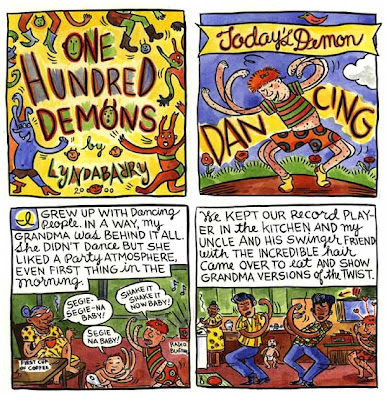
The image above looks a bit washed out on my monitor, and maybe yours, so here's another one where you can see the intense color she uses, a feature which really made the book for me. I would have loved it just for Barry's humor (especially as a highlight for actually serious topics) and self-deprecation and story-telling skills, but the lush gorgeousness of the art was icing on the cake.


Barry has many other books, and as soon as I finish writing this, I'm going to add them all to my wishlist.

Monday, June 2, 2008

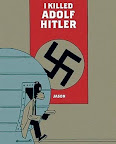
I Killed Adolph Hitler by Jason

Jason's comic Low Moon is currently running in the New York Times Sunday Magazine. If you click the link, you can read the strips that have been published there so far.

I bought I Killed Adolph Hitler for my husband for his birthday, after reading a review of it. He loves graphic novels, and Jason's author description was surreal in a way I thought my husband would apprecite: "Jason was born in Norway in 1965. Suddenly he spoke to a cat. Winter filled the room. They could see the ocean." But what actually happened is that my husband read that and called Jason a wanker. Still, he loved the book, and I enjoyed it, too.

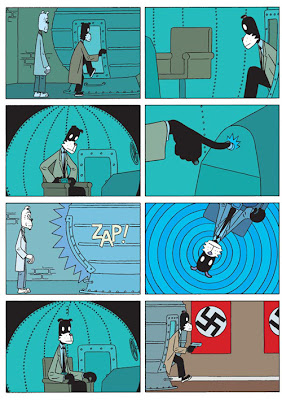
The main character in this graphic novel is a hit man. The back of the book says that in the society in which this story is set, murder-for-hire is legal, but when reading the book myself, I didn't get the sense that it was either legal or illegal. That might just be something I missed, but it doesn't matter either way. The main character is a hit man, and is approached by a scientist who has invented a time machine. The scientist wants him to travel back in time and kill Hitler. Unfortunately, the time machine will only work once every fifty years, so the hit man has to get it right on the first try. Of course, he doesn't. He messes up, which leads to some playful experimentation with the idea of time travel. And that playfulness was what I liked best about this book.

I also like Jason's use of color. He's known for his minimalist drawings, which I enjoy. But what drew my eye most was his heavy use of blues and greens with muted greys and browns, which make his rarer red tones really pop out. I also love the way his characters are different animals, and I spent some time trying to figure out if different animals represent different types of people, as they do in Spiegelman's Maus. But although most of the main characters have dog-like qualities, other animals (birds, bunnies, and my favorite, a cat with a hipster beard reading a paper in the hit man's waiting room) seem random. I admire that; I feel it sends a message that people just look different, and maybe we shouldn't make such a big deal about what their appearances say about them.


Cross-posted in my blog.